NASAMS anti-aircraft missile system
NASAMS anti-aircraft missile system
:extract_focal()/https%3A%2F%2Fmissilery.info%2Ffiles%2Fm%2Fnasams%2Fnasams03.jpg)
The missile is equipped with a directional high-explosive fragmentation warhead , which is detonated by an active radar or contact fuse.
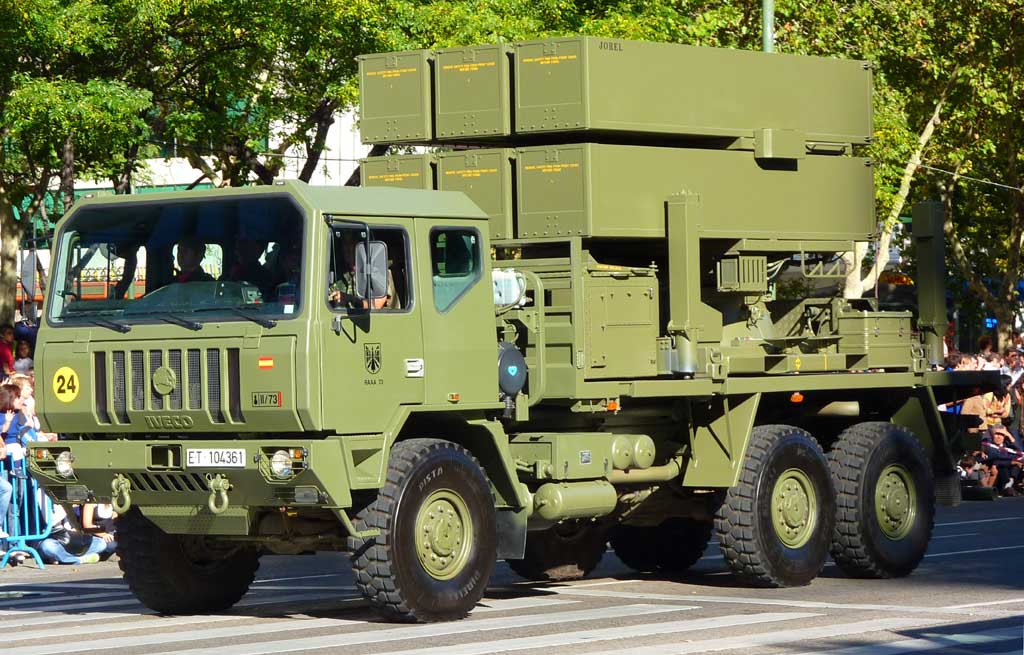
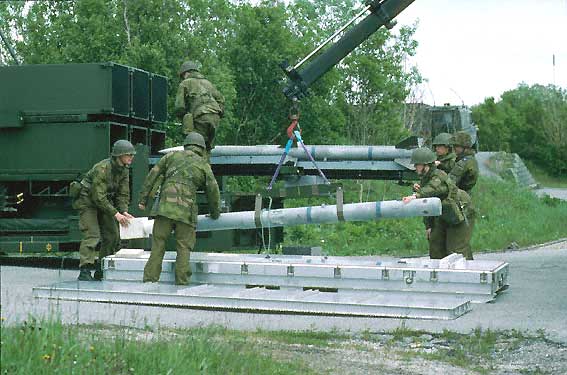
SAMs are stored, transported and launched from transport and launch containers. A package of six such TPKs is placed on a launcher made on the chassis of a Scania P113 off-road vehicle (4x4 + 2 wheel arrangement). In the Spanish army, the launcher is made on the Iveco chassis (see photo ). The loading of missiles into the TPK is carried out using a loading machine, which is part of the complex (see photo). Missiles are launched at a fixed elevation angle of 30°. In the stowed position, transport and launch containers with missiles are located horizontally. To increase the survivability of the complex, it is planned to disperse the launchers from the positions of the control center and radar at a distance of up to 25 km, while communication with the installations can be organized via cable, fiber-optic or digital communication lines. Thales Communication's communication equipment based on the TAS 300 switch (Tactical Eurocom switch) provides high-speed exchange, encoding and decoding of traffic between network nodes, interface with STANAG 4206 and ISDN networks.
:extract_focal()/https%3A%2F%2Fmissilery.info%2Ffiles%2Fm%2Fnasams%2Fraytheon.jpg)
The AN/TPQ-64 multifunctional radar station, developed on the basis of the AN/TPQ-36A artillery position detection radar, provides detection, identification and simultaneous tracking of up to 60 air targets, as well as guidance of up to three missiles selected from them. Radar AN / TPQ-64 - pulse-Doppler, three-coordinate, equipped with a phased antenna array and an integrated interrogator "friend or foe" type Mk.XII. The radar provides a survey of space due to the mechanical rotation of the antenna in azimuth and electronic scanning in elevation. The operation of the radar is controlled by the computer of the fire control center. The radar forms a needle-type radiation pattern with a low level of side lobes and is capable of compressing pulses, selecting moving targets, changing the power and type of the emitted signal. The radar operates in the frequency range of 8-10 GHz (field of view in azimuth - 360 °, in elevation - 60 °, survey rate in azimuth - 180 ° per second, position accuracy in range - 30 m, in azimuth - 0.2 °, in angle places - 0.17 °, resolution in range 150 m, in azimuth - 2 °, in elevation - 1.7 °). Time of deployment and preparation for work - 10 min. All station equipment is installed on a towed trailer.
To ensure combat work in a difficult jamming environment, the NASAMS complex is equipped with optoelectronic guidance - NTAS (Norwegian Tracking Adjunct System).
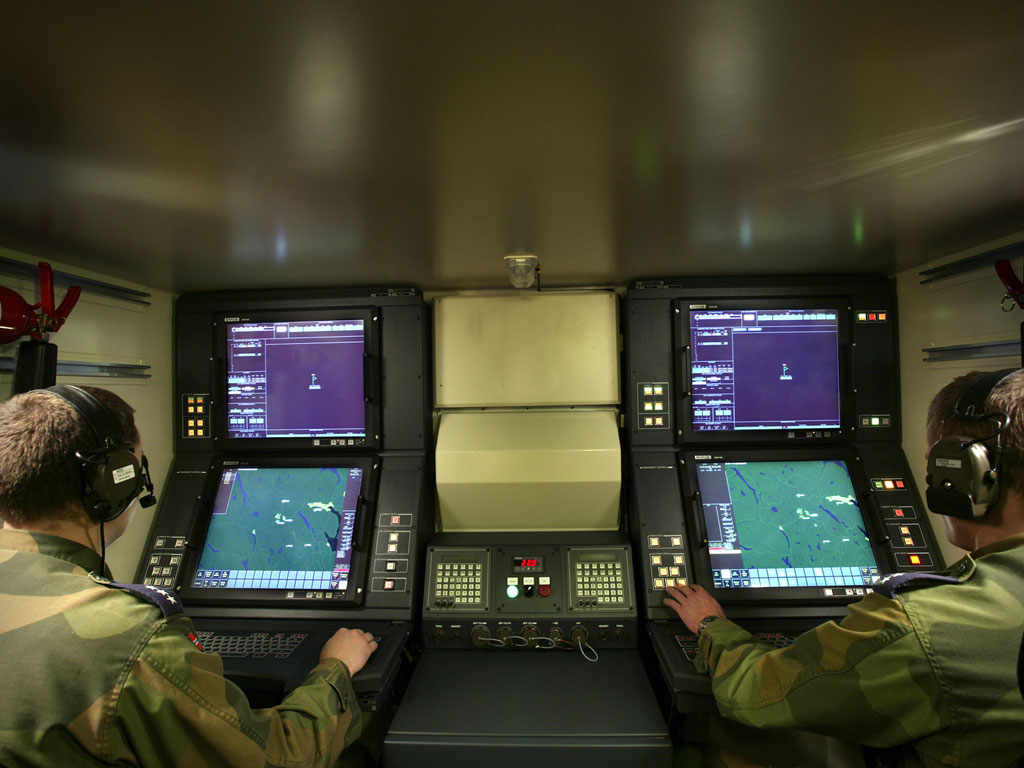
Information about the air situation from the radar (data update period - 2 s) is transmitted to the fire control point, which includes two high-performance computers, a multi-purpose modular control panel with display and control systems, data transmission equipment and communications equipment (see photo ). The console has two automated workstations (AWPs) duplicating each other with the same controls. Each workstation is equipped with three displays, two of which display the entire air and combat situation, and the third shows the status and readiness of the complex's systems. Detailed information about the direction of movement, speed and height of any target can be obtained by the operator by entering the azimuth marker and pressing the data readout button to display them on the indicator screen.
The firing unit of the complex is a platoon armed with three launchers with six missiles each, an AN / TPQ-64 multifunctional radar and a fire control point. The main tactical unit of the NASAMS air defense system is the battery. It consists of three fire platoons (a total set of 54 missiles), united in an information network in such a way that each of the three radars is capable of replacing all the others. The battery command post (located at one of the fire control posts) can receive target designation from a higher headquarters and issue data on the air situation to the platoon fire control posts. All 54 missiles can be fired at various targets within 12 seconds.
The NASAMS II complex differs from the prototype in greater mobility - the NASAMS II launchers are mounted on a Bv 206 off-road chassis. The battery includes 4 platoons instead of three, six AN / TPQ-64 radars instead of three and 12 launchers instead of nine. NASAMS II software is compatible with communications systems used by the Norwegian Army.


Коментарі
Дописати коментар
Олег Мічман в X: «Donations and support for media resources, bloggers, projects, and individuals. https://t.co/HPKsNRd4Uo https://t.co/R6NXVPK62M» / X
https://twitter.com/olukawy/status/1703876551505309973